
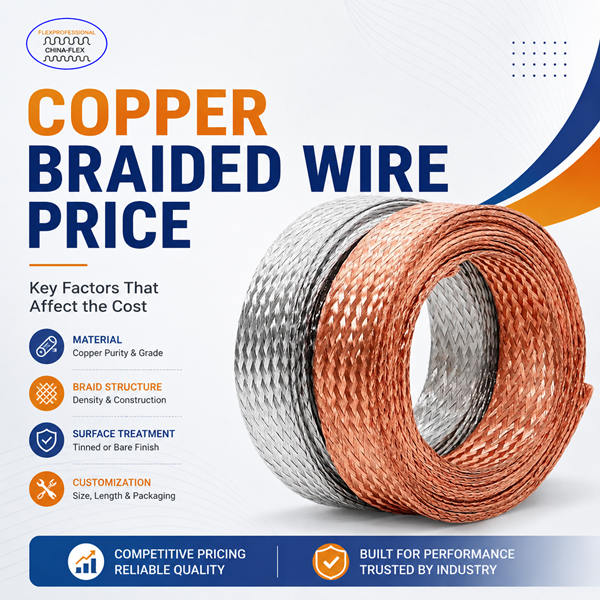
When customers purchase copper braided wire, price is often one of the most important concerns. However, the copper braided wire price is not determined by only one factor. It depends on raw copper cost, wire specification, braid structure, conductivity requirements, surface treatment, production process, order quantity, and customization needs.
Understanding these factors can help buyers compare quotations more accurately and choose the right copper braided wire for electrical, grounding, shielding, and flexible connection applications.
What Is Copper Braided Wire?
Copper braided wire is made by braiding multiple strands of fine copper wire into a flexible and conductive structure. It is widely used in electrical connection, grounding systems, power transmission, cable shielding, battery connections, switchgear, transformers, welding equipment, and industrial machinery.
Compared with solid copper conductors, copper braided wire has better flexibility, vibration resistance, and installation convenience. Therefore, it is commonly used in applications where movement, bending, or limited installation space is required.
1. Raw Copper Price
The most important factor affecting copper braided wire price is the raw material cost. Copper is a commodity material, and its market price changes regularly.
When copper prices rise, the cost of copper braided wire usually increases. When copper prices fall, the quotation may also become more competitive. Since copper accounts for a large part of the total product cost, raw material price fluctuation directly affects the final selling price.
For bulk orders, many suppliers calculate the quotation based on the current copper market price. Therefore, customers are advised to confirm the price validity period when requesting a quotation.
2. Copper Purity and Conductivity
Different copper materials have different purity levels and conductivity performance. High-purity copper usually provides better electrical conductivity, but the cost is also higher.
Common material options include:
- Bare copper wire
- Tinned copper wire
- Oxygen-free copper wire
- High-conductivity copper wire
For applications that require excellent electrical performance, low resistance, and stable current transmission, higher-grade copper is usually recommended. However, if the application is general grounding or shielding, standard copper braided wire may be more cost-effective.
3. Wire Diameter and Strand Size
The diameter of each copper wire strand also affects the price. Copper braided wire can be made from very fine copper strands or relatively thicker strands.
Fine wire strands usually provide better flexibility, but they may require more precise production control and longer processing time. Thicker strands may be stronger but less flexible.
When customers compare prices, they should check not only the overall width and thickness, but also the single wire diameter, strand quantity, and braid density. These technical details can make a significant difference in both performance and cost.
4. Braid Structure and Coverage
The braid structure is another key factor. Copper braided wire can be produced in different braid patterns, widths, thicknesses, and densities.
A higher braid density usually means more copper material is used per meter. As a result, the price will be higher. A tighter braid can improve conductivity, mechanical strength, and shielding performance, but it also increases material consumption and production cost.
Important structure parameters include:
| Parameter | Impact on Price |
|---|---|
| Braid width | Wider products use more copper |
| Braid thickness | Thicker products increase material weight |
| Braid density | Higher density means more copper and longer production time |
| Number of strands | More strands increase flexibility and cost |
| Cross-sectional area | Larger area usually means higher current capacity and higher price |
5. Cross-Sectional Area and Current Capacity
Copper braided wire is often selected according to its cross-sectional area and current carrying capacity. Larger cross-sectional area means better conductivity and higher current capacity, but it also requires more copper material.
For example, a copper braided wire used for low-current shielding will cost much less than a heavy-duty copper braid used for transformer connection or high-current grounding.
Before buying, customers should confirm the required current rating, working environment, and installation method. Choosing the correct specification can avoid both underperformance and unnecessary cost.
6. Surface Treatment: Bare Copper or Tinned Copper
Surface treatment has a direct influence on copper braided wire price.
Bare copper braided wire is generally more economical and suitable for many standard electrical applications. However, bare copper can oxidize over time, especially in humid or corrosive environments.
Tinned copper braided wire has a tin coating on the copper surface. It offers better oxidation resistance, corrosion resistance, and solderability. Because of the additional tinning process and material cost, tinned copper braided wire is usually more expensive than bare copper braided wire.
Customers should choose the surface treatment according to the working environment and service life requirements.
7. Product Form and Processing Requirements
Copper braided wire can be supplied in different forms, such as:
- Flat copper braided wire
- Round copper braided wire
- Copper braided tape
- Copper flexible connector
- Copper braid with terminals
- Insulated copper braided wire
- Customized copper braided grounding strap
If customers need only standard copper braid in rolls, the price is usually lower. However, if additional processing is required, such as cutting, punching, welding, crimping terminals, insulation sleeving, or custom packaging, the cost will increase.
Processed copper braided connectors are more convenient for installation, but they require extra labor, tooling, and quality inspection.
8. Customization Requirements
Customized copper braided wire usually costs more than standard products. Custom requirements may include special width, thickness, cross-sectional area, terminal type, hole size, insulation material, length tolerance, packaging method, or special testing standards.
Customization may also require sample production and technical confirmation before mass production. Therefore, customers should provide complete drawings, specifications, or application details to help the supplier quote accurately.
9. Order Quantity
Order quantity also affects the unit price. Generally, larger orders can reduce the average production cost because raw material purchasing, machine setup, production planning, and packaging can be arranged more efficiently.
For small trial orders or sample orders, the unit price may be higher due to setup cost and handling cost. For long-term purchasing plans, customers can negotiate better pricing based on stable demand.
10. Quality Control and Testing Requirements
Reliable copper braided wire should have stable conductivity, accurate dimensions, good flexibility, clean surface, and consistent braid structure.
Some customers may require additional testing or documents, such as:
- Material certificate
- Conductivity test
- Resistance test
- Dimension inspection report
- Tensile strength test
- RoHS or environmental compliance documents
- Custom quality inspection report
Additional testing and documentation may increase the cost, but they are important for projects with strict quality requirements.
How to Get an Accurate Copper Braided Wire Price
To receive a precise quotation, customers should provide the following information:
| Required Information | Example |
|---|---|
| Material | Bare copper / tinned copper / oxygen-free copper |
| Product type | Flat braid / round braid / flexible connector |
| Width and thickness | 20 mm width, 3 mm thickness |
| Cross-sectional area | 25 mm², 50 mm², 100 mm² |
| Single wire diameter | 0.10 mm, 0.15 mm, 0.20 mm |
| Length | Roll length or cut length |
| Terminal requirement | With or without copper terminals |
| Surface treatment | Bare or tinned |
| Application | Grounding, shielding, power connection |
| Order quantity | Meters, pieces, or kilograms |
The more detailed the information, the more accurate the quotation will be.
Conclusion
The copper braided wire price is mainly affected by raw copper cost, copper purity, braid structure, wire diameter, cross-sectional area, surface treatment, customization, processing requirements, order quantity, and quality testing standards.
When comparing quotations, buyers should not only look at the unit price. They should also compare material quality, copper weight, conductivity, flexibility, workmanship, and supplier service.
A suitable copper braided wire can provide stable electrical performance, reliable grounding, excellent flexibility, and long service life for industrial and electrical applications.