Flat Copper Braided Wire: Flexible Conductive Solution for Industrial Applications
Flat copper braided wire is an important electrical conductive material used in grounding systems, power connections, cable shielding, electrical equipment, switchgear, transformers, battery systems, and industrial machinery. It is made by braiding multiple strands of fine copper wire into a flat and flexible structure.
Compared with solid copper bars or rigid conductors, flat copper braided wire offers excellent flexibility, stable conductivity, good vibration resistance, and easy installation. Therefore, it is widely used in applications where electrical connection and mechanical movement are required at the same time.
What Is Flat Copper Braided Wire?
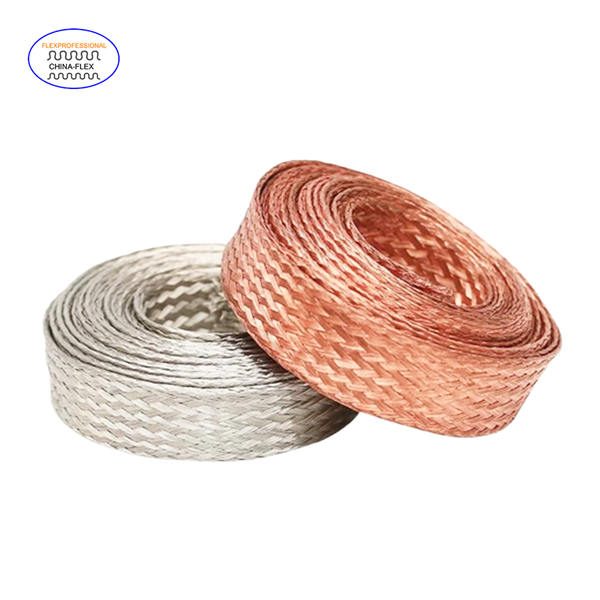
Flat copper braided wire is a flexible copper conductor with a flat woven structure. Fine copper wires are braided together to form a soft and conductive strip. The flat shape makes it easy to install in narrow spaces, connect electrical components, and provide reliable current transmission.
It can be supplied in rolls or processed into customized copper braided connectors with terminals, holes, insulation sleeves, or special lengths according to customer requirements.
Common types include:
- Bare flat copper braided wire
- Tinned flat copper braided wire
- Oxygen-free copper braided wire
- Flexible copper braided tape
- Flat copper grounding braid
- Copper braided flexible connector
Main Features of Flat Copper Braided Wire
1. Excellent Electrical Conductivity
Copper has very good electrical conductivity, making flat copper braided wire suitable for power transmission, grounding, and electrical connection. A properly selected cross-sectional area can ensure stable current carrying capacity and reduce resistance loss.
2. High Flexibility
The braided structure allows the conductor to bend easily. This makes it suitable for applications where equipment vibration, movement, thermal expansion, or limited installation space may occur.
Compared with rigid copper busbars, flat copper braid is easier to install and can reduce stress on connection points.
3. Good Vibration Resistance
In industrial machinery, motors, transformers, and electrical cabinets, vibration can affect the reliability of electrical connections. Flat copper braided wire provides flexible connection and helps absorb mechanical stress, improving long-term connection stability.
4. Easy Installation
Because of its flat and soft structure, flat copper braided wire can be cut, bent, shaped, punched, welded, or crimped according to different installation needs. It can also be customized with copper terminals for direct assembly.
5. Optional Surface Treatment
Flat copper braided wire can be produced with bare copper or tinned copper.
Bare copper is economical and suitable for general indoor applications. Tinned copper provides better oxidation resistance, corrosion resistance, and solderability, making it suitable for humid or harsh environments.
Common Applications of Flat Copper Braided Wire
Flat copper braided wire is widely used in many electrical and industrial fields.
| Application | Function |
|---|---|
| Grounding systems | Provides flexible and reliable grounding connection |
| Switchgear | Connects electrical components and busbars |
| Transformers | Used for flexible conductive connection |
| Battery systems | Connects battery modules and power terminals |
| Cable shielding | Provides electromagnetic shielding support |
| Motors and generators | Absorbs vibration and ensures stable current transfer |
| Welding machines | Supports high-current flexible connection |
| Electrical cabinets | Used as grounding straps or bonding conductors |
| Railway and automotive systems | Provides flexible conductive connection |
| Industrial machinery | Connects moving or vibrating electrical parts |
Bare Copper vs. Tinned Flat Copper Braided Wire
When choosing flat copper braided wire, customers often need to decide between bare copper and tinned copper.
Bare Flat Copper Braided Wire
Bare copper braid has natural copper color and good conductivity. It is usually more economical and suitable for standard electrical connection and grounding applications.
It is commonly used in dry indoor environments where oxidation resistance is not the main concern.
Tinned Flat Copper Braided Wire
Tinned copper braid is coated with a thin layer of tin. This surface treatment improves corrosion resistance and oxidation resistance. It also improves soldering performance.
Tinned flat copper braided wire is suitable for humid environments, outdoor equipment, marine applications, electrical cabinets, and long-service-life projects.
Key Specifications to Confirm Before Ordering
To select the right flat copper braided wire, customers should confirm the following technical details:
| Specification | Why It Matters |
|---|---|
| Material | Bare copper, tinned copper, or oxygen-free copper |
| Width | Affects installation space and current capacity |
| Thickness | Affects flexibility and copper weight |
| Cross-sectional area | Determines current carrying capacity |
| Single wire diameter | Influences flexibility and braid structure |
| Braid density | Affects conductivity, strength, and appearance |
| Surface treatment | Determines oxidation and corrosion resistance |
| Length | Roll supply or cut-to-length processing |
| Terminal requirement | Needed for customized flexible connectors |
| Application | Helps select suitable structure and material |
Providing clear specifications helps suppliers offer a more accurate quotation and suitable product recommendation.
Factors Affecting Flat Copper Braided Wire Price
The price of flat copper braided wire is mainly influenced by raw copper cost, product size, copper weight, braid density, surface treatment, customization, and order quantity.
Key price factors include:
- Current copper market price
- Copper purity and material grade
- Width and thickness of the braid
- Cross-sectional area
- Single wire diameter
- Bare copper or tinned copper surface
- Standard roll supply or customized connector processing
- Required terminals, holes, insulation, or packaging
- Quantity and delivery requirement
When comparing quotations, customers should not only check the price per meter. They should also compare copper weight, conductivity, flexibility, surface quality, and product consistency.
Customized Flat Copper Braided Connectors
In addition to supplying flat copper braided wire in rolls, many customers require processed copper braided flexible connectors.
Customized processing may include:
- Cutting to fixed length
- Pressing or welding copper terminals
- Punching holes
- Adding insulation sleeves
- Tin plating or nickel plating
- Special bending shape
- Custom packaging and labeling
These customized copper braid connectors are widely used in power equipment, electrical cabinets, transformers, battery packs, and grounding systems.
How to Choose a Reliable Flat Copper Braided Wire Supplier
A reliable supplier should provide stable material quality, accurate dimensions, clean surface, consistent braid structure, and flexible customization service.
When selecting a supplier, customers should pay attention to:
- Copper material quality
- Production capability
- Braid uniformity
- Dimensional accuracy
- Conductivity performance
- Custom processing ability
- Quality inspection process
- Delivery time
- Technical support and communication efficiency
For industrial and electrical projects, stable quality is more important than simply choosing the lowest price.
Conclusion
Flat copper braided wire is a flexible, conductive, and reliable solution for grounding, electrical connection, shielding, and industrial power transmission. With excellent flexibility, good conductivity, and convenient installation, it is widely used in electrical equipment, switchgear, transformers, batteries, motors, and machinery.
When choosing flat copper braided wire, customers should consider material, width, thickness, cross-sectional area, surface treatment, flexibility, current capacity, and customization needs. A suitable product can improve electrical performance, reduce installation difficulty, and ensure long-term connection reliability.